




Fan Static Pressure (SP) is one of the most important parameters used for HVAC, Pressurization, Fresh Air, Smoke Exhaust, and Ventilation Fan selection. Incorrect static pressure calculation can lead to inadequate airflow, excessive noise, and increased energy consumption.
What is Fan Static Pressure?
Static Pressure is the resistance that a fan must overcome to move air through a system.
It includes:
- Duct friction loss
- Filter loss
- Coil loss
- Damper loss
- Grille/Diffuser loss
- Equipment loss
- Safety margin
Formula
Total Static Pressure (ESP)

= Duct Loss
+ Filter Loss
+ Coil Loss
+ Damper Loss
+ Grille Loss
+ Equipment Loss
+ Safety Margin
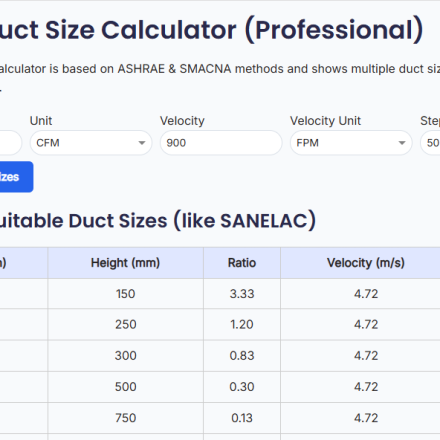
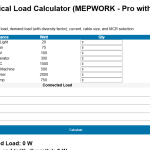
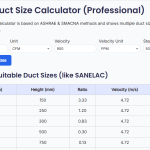
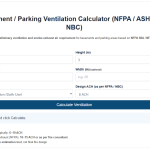
Fan Static Pressure Calculator
Input Parameters
| Parameter | Unit |
|---|---|
| Airflow | CFM / CMH |
| Duct Length | m |
| Friction Rate | Pa/m |
| Filter Loss | Pa |
| Coil Loss | Pa |
| Fire Damper Loss | Pa |
| Volume Damper Loss | Pa |
| Grille/Diffuser Loss | Pa |
| Equipment Loss | Pa |
| Safety Margin | % |
Calculation Formula
Duct Loss
Duct Loss (Pa)

= Duct Length × Friction Rate
Example:
= 40 × 1.5

= 60 Pa
Total Static Pressure
ESP

= Duct Loss
+ Filter Loss
+ Coil Loss
+ Fire Damper Loss
+ Volume Damper Loss
+ Grille Loss
+ Equipment Loss
Safety Margin
Final ESP

= ESP × (1 + Safety Margin%)
Design Example
Input
| Parameter | Value |
|---|---|
| Airflow | 10,000 CMH |
| Duct Length | 40 m |
| Friction Rate | 1.5 Pa/m |
| Filter Loss | 120 Pa |
| Coil Loss | 80 Pa |
| Fire Damper | 50 Pa |
| Volume Damper | 30 Pa |
| Grille Loss | 25 Pa |
| Equipment Loss | 20 Pa |
| Safety Margin | 10% |
Calculation
Duct Loss
40 × 1.5

= 60 Pa
ESP
60 + 120 + 80 + 50 + 30 + 25 + 20

= 385 Pa
Final ESP
385 × 1.10

= 424 Pa
Result
Required Fan Static Pressure = 425 Pa
Equivalent:
425 ÷ 9.81

= 43.3 mmWG
Typical Pressure Loss Values
| Component | Typical Loss |
|---|---|
| Air Filter | 50 – 250 Pa |
| Cooling Coil | 50 – 150 Pa |
| Fire Damper | 30 – 100 Pa |
| Volume Control Damper | 20 – 50 Pa |
| Diffuser | 20 – 50 Pa |
| Louvers | 25 – 75 Pa |
| HEPA Filter | 250 – 500 Pa |
Unit Conversion
| Unit | Equivalent |
|---|---|
| 1 mmWG | 9.81 Pa |
| 10 mmWG | 98.1 Pa |
| 25 mmWG | 245 Pa |
| 50 mmWG | 490 Pa |
| 100 mmWG | 981 Pa |
Recommended Fan ESP
| Application | ESP Range |
|---|---|
| Toilet Exhaust | 50–150 Pa |
| Basement Ventilation | 150–300 Pa |
| Fresh Air Fan | 250–500 Pa |
| AHU Supply Fan | 300–800 Pa |
| Smoke Exhaust Fan | 500–1000 Pa |
| Staircase Pressurization | 250–500 Pa |
| Lift Well Pressurization | 250–400 Pa |
Common Mistakes
❌ Ignoring filter pressure drop
❌ Ignoring future dirty filter condition
❌ Not including fire damper losses
❌ Not adding safety factor
❌ Using only duct friction loss
Fan Selection Checklist
- Airflow (CFM/CMH)
- Total Static Pressure (Pa/mmWG)
- Fan Efficiency
- Motor Power
- Noise Criteria
- VFD Requirement
- Fire Rating Requirement
- NBC Compliance
FAQ
What is ESP in HVAC?
ESP (External Static Pressure) is the total resistance that the fan must overcome in the duct system.
Which unit is used for static pressure?
Most HVAC consultants use:
- Pa (Pascal)
- mmWG (Millimeter Water Gauge)
How much safety factor should be added?
Typically 10% to 15%.
What is a good ESP for an AHU?
Normally between 300 Pa and 800 Pa, depending on filters, coils, and ductwork.
📢 Why Download from MEPWORK?
- Free DWG files
- Ready-to-use drawings
- Designed for engineers
- Updated as per industry standards
MEPWORK.IN is developed by an MEP engineering professional with hands-on experience in building services design and execution.
The platform is created to solve real-world engineering problems and provide practical tools for faster and more accurate project work.
Download free AutoCAD DWG files for MEP engineers including plumbing, HVAC, fire alarm, and electrical systems.
All drawings are ready to use and based on industry standards.
All resources are regularly updated as per latest standards (NBC 2016, IS Codes, NFPA, and 2026 industry practices).