












HVAC Duct Size Calculator
An HVAC duct size calculator helps engineers determine the correct duct dimensions required to deliver a specific airflow in heating, ventilation, and air conditioning systems.
Proper duct sizing ensures:
- Balanced air distribution
- Reduced energy loss
- Lower noise levels
- Efficient HVAC performance
If ducts are too small, airflow resistance increases and reduces system efficiency.
If ducts are too large, installation costs increase unnecessarily.
This HVAC duct sizing tool calculates rectangular duct dimensions based on airflow and velocity.
HVAC Duct Sizing Formula
The fundamental airflow equation used in HVAC design is:
Q = V × A
Where:
| Symbol | Description |
|---|---|
| Q | Airflow rate |
| V | Air velocity |
| A | Duct cross-sectional area |
Rearranging the formula:
A = Q / V
Where:
- A = duct area (m²)
- Q = airflow (m³/s)
- V = air velocity (m/s)
Example HVAC Duct Size Calculation
Given:
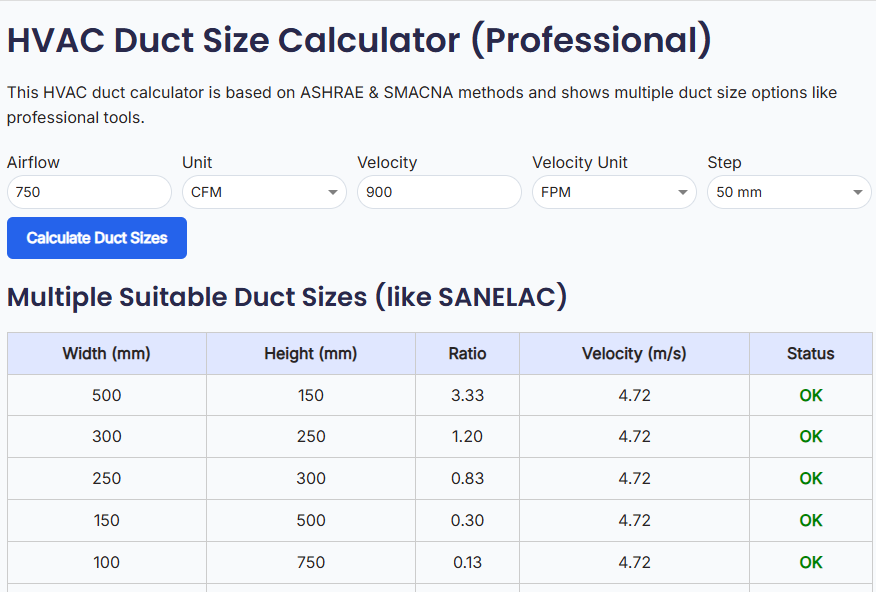
- Airflow = 750 CFM
- Velocity = 900 FPM
Step 1 Convert airflow to m³/s
1 CFM = 0.0004719 m³/s
750 CFM = 0.354 m³/s
Step 2 Convert velocity to m/s
900 FPM = 4.57 m/s
Step 3 Calculate duct area
A = Q / V
A = 0.354 / 4.57
A = 0.0775 m²
Step 4 Determine duct dimensions
Possible rectangular duct sizes:
| Width (mm) | Height (mm) |
|---|---|
| 400 | 200 |
| 350 | 225 |
| 300 | 250 |
These dimensions deliver the required airflow.
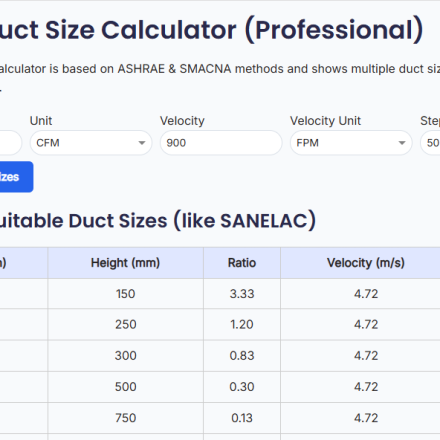
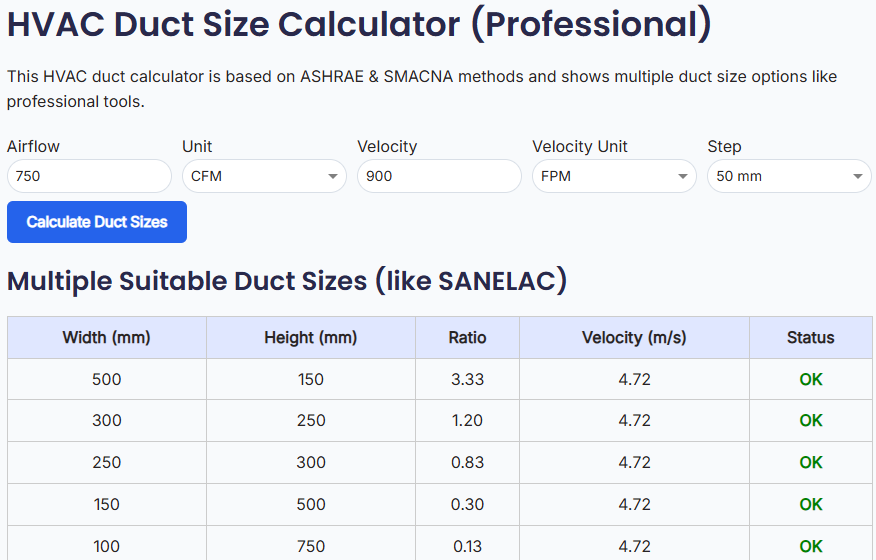
HVAC Duct Size Calculator (Professional)
This HVAC duct calculator is based on ASHRAE & SMACNA methods and shows multiple duct size options like professional tools.
Recommended HVAC Air Velocity
Typical duct velocity ranges:
| Duct Type | Velocity |
|---|---|
| Main supply duct | 6–10 m/s |
| Branch duct | 4–6 m/s |
| Return duct | 3–5 m/s |
Maintaining proper velocity reduces noise and pressure losses.
HVAC Duct Friction Loss
Friction loss occurs when air flows through ducts due to:
- duct roughness
- bends and fittings
- air turbulence
Typical friction rate used in HVAC design:
0.6 – 1.0 Pa/m
Lower friction improves system efficiency.
Rectangular vs Round Duct
Rectangular Duct
Advantages:
- Fits in limited ceiling space
- Easier installation in buildings
Disadvantages:
- Higher friction loss
Round Duct
Advantages:
- Lowest air resistance
- Better airflow efficiency
Disadvantages:
- Requires more installation space
Free HVAC Duct Size Calculator
Use the BrickMate HVAC duct calculator to instantly determine:
- rectangular duct sizes
- airflow velocity
- required duct area
The calculator supports:
- CFM
- m³/h
- L/s
This makes it useful for both ASHRAE and international HVAC projects.
Download HVAC Duct Size Calculator in excel
Engineers can also download the HVAC duct sizing Excel sheet for quick calculations during design and site work.
Download HVAC Duct Size Excel Calculator
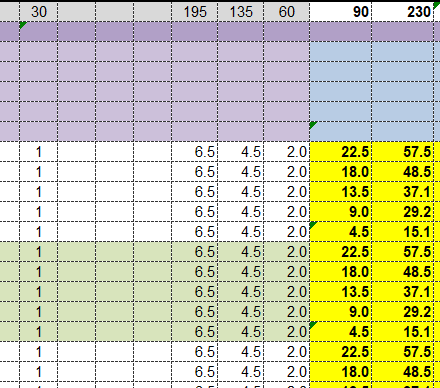
This Excel tool automatically calculates:
- airflow conversion
- duct area
- rectangular duct dimensions
- airflow velocity
HVAC Standards for Duct Design
Common standards used in duct sizing include:
- ASHRAE Handbook – HVAC Systems
- SMACNA Duct Design Guide
- IS 655 – Metal Air Duct Standards
Following these standards ensures proper system performance.
FAQ
What is duct sizing in HVAC?
Duct sizing is the process of determining the correct duct dimensions required to deliver the desired airflow efficiently in HVAC systems.
How do you calculate HVAC Duct Size Calculator
HVAC duct size is calculated using the airflow equation:
Area = Airflow / Velocity
The calculated area is then used to determine suitable duct dimensions.
What is the recommended air velocity in HVAC ducts?
Typical air velocity ranges between 3 m/s and 10 m/s depending on duct type.

HVAC Duct Size Calculator (CFM, Velocity & Area) + Free Excel Download 5.45 KB 197 downloads
HVAC duct sizing is a critical part of air conditioning system design. Incorrect...📢 Why Download from MEPWORK?
- Free DWG files
- Ready-to-use drawings
- Designed for engineers
- Updated as per industry standards
MEPWORK.IN is developed by an MEP engineering professional with hands-on experience in building services design and execution.
The platform is created to solve real-world engineering problems and provide practical tools for faster and more accurate project work.
Download free AutoCAD DWG files for MEP engineers including plumbing, HVAC, fire alarm, and electrical systems.
All drawings are ready to use and based on industry standards.
All resources are regularly updated as per latest standards (NBC 2016, IS Codes, NFPA, and 2026 industry practices).