Learn ventilation design for basement parking with layout, calculations, fans, and system design. Includes PDF, PPT, and Indian standards for basement ventilation.
Ventilation Design for Basement Parking
Ventilation design for basement parking is a critical part of HVAC and fire safety systems in buildings. Proper ventilation ensures removal of toxic gases such as CO (carbon monoxide), improves air quality, and maintains safe conditions.
In modern buildings, ventilation for basement parking is mandatory as per building codes and safety standards.
This guide explains:
✔ Basement ventilation layout
✔ Ventilation system design
✔ Fan selection
✔ Indian standards
✔ Modern ventilation design methods
Why Ventilation for Basement Parking is Important
Basement parking areas accumulate harmful gases from vehicles.
Main pollutants include:
- Carbon monoxide (CO)
- Nitrogen oxides (NOx)
- Smoke during fire
Without proper ventilation, these gases can become dangerous.
That is why ventilation for basement parking is essential for:
✔ Human safety
✔ Fire protection
✔ Air quality control
Types of Basement Ventilation Systems
1️⃣ Natural Ventilation
Natural ventilation uses basement ventilation windows and openings.
Used when:
- Basement is partially open
- Adequate airflow exists
However, it is not suitable for large basements.
2️⃣ Mechanical Ventilation (Most Common)
Mechanical systems use:
- Basement ventilation fan
- Exhaust fans
- Fresh air supply
This is the best ventilation design for basement parking.
3️⃣ Jet Fan System (Modern Solution)
A modern ventilation design for basement parking uses jet fans.
Features:
✔ No duct required
✔ Efficient air circulation
✔ Space saving
Widely used in malls and commercial buildings.
Basement / Parking Ventilation Calculator (NFPA / ASHRAE / NBC)
This tool estimates preliminary ventilation and smoke exhaust air requirement for basements and parking areas based on NFPA 88A / NFPA 90A, ASHRAE and NBC practice.
• Normal ventilation typically: 6–10 ACH
• Emergency smoke exhaust (NFPA): 10–15 ACH or as per fire consultant
• This is a preliminary estimation tool, not final fire design.
Ventilation Design for Basement Parking in India
In India, ventilation design follows:
- NBC (National Building Code)
- Fire safety norms
- Local authority guidelines
Typical requirements:
✔ 6–10 air changes per hour
✔ CO level control
✔ Smoke extraction system
For ventilation design for basement parking in India, mechanical systems are generally mandatory.
Basement Ventilation System Design
Designing a basement ventilation system involves several steps.
Step 1: Calculate Air Changes
Formula:
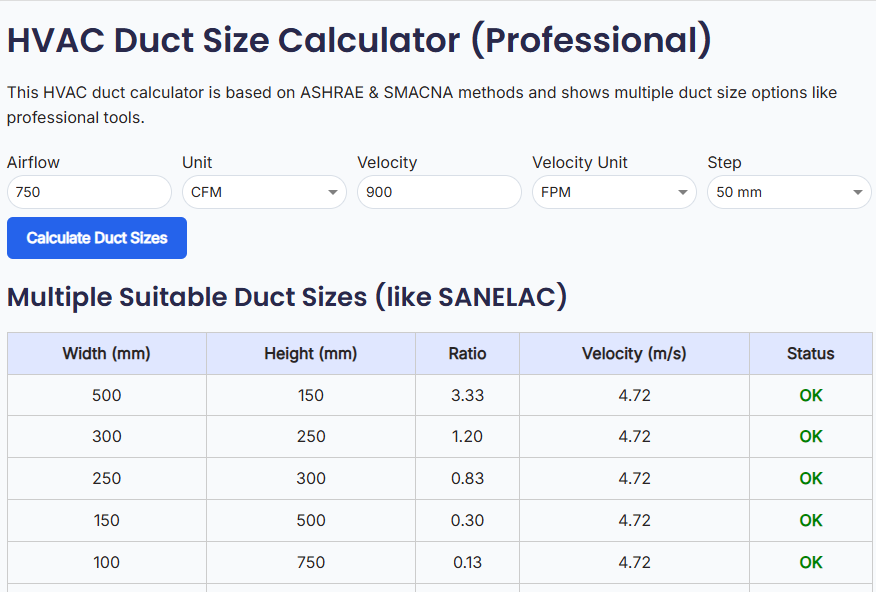
Airflow (CFM) = Volume × Air Changes per Hour / 60
Step 2: Determine Basement Volume
Volume = Length × Width × Height
Step 3: Select Ventilation System
Choose between:
- Exhaust fan system
- Jet fan system
Step 4: Fan Selection
Use:
- Basement ventilation fan
- Axial fans
- Centrifugal fans
Step 5: Layout Design
Prepare a proper basement ventilation layout showing:
✔ Fan location
✔ Airflow direction
✔ Fresh air entry
Basement Ventilation Layout
A proper layout ensures effective air circulation.
Key design points:
✔ Fresh air inlet at one side
✔ Exhaust fans at opposite side
✔ Avoid dead air zones
A good layout improves system performance.
How to Ventilate a Basement
Many users search practical questions like:
How to ventilate a basement?
- Use exhaust fans
- Provide fresh air openings
- Install duct system
How to improve ventilation in a basement?
✔ Increase air changes
✔ Use high-capacity fans
✔ Add additional ducts
How to create ventilation in a basement?
✔ Install ventilation system
✔ Add windows or openings
✔ Use mechanical ventilation
Ventilation for Basement Without Windows
For enclosed basements:
✔ Use mechanical ventilation
✔ Install ducted exhaust system
✔ Maintain continuous airflow
This is critical for ventilation for basement without windows.
Car Parking Ventilation + Jet Fan + CO Sensor Estimator (NFPA / ASHRAE)
This tool gives preliminary estimation of ventilation air, number of jet fans and CO sensors for enclosed car parks based on NFPA / ASHRAE / NBC planning practice.
• 1 CO sensor ≈ 400 m² coverage
• 1 Jet fan ≈ 350 m² coverage
• Final quantities depend on CFD, layout & consultant design.
Basement Ventilation for Different Applications
Ventilation for Basement Room
Use small exhaust fans and fresh air vents.
Ventilation for Basement Gym
Higher airflow required due to occupancy.
Ventilation for Basement Kitchen
Use:
✔ Exhaust hood
✔ Duct ventilation
Ventilation for Basement Workshop
Remove fumes and dust using high-capacity fans.
Ventilation for Basement Bathroom
Use:
✔ Exhaust fan
✔ Moisture control system
Ventilation for Basement Sauna
Requires heat-resistant ventilation system.
Modern Ventilation Design for Basement
Modern systems use:
✔ Jet fans
✔ CO sensors
✔ Automatic control
These systems operate only when required, saving energy.
This is known as modern ventilation design for basement parking.
Best Ventilation Design for Basement Parking
The best system includes:
✔ Mechanical ventilation
✔ Jet fan system
✔ Smoke extraction
This ensures:
- energy efficiency
- safety
- compliance
Basement Ventilation Design PDF / PPT
You can provide downloadable resources:
- ventilation design for basement parking pdf
- ventilation design for basement parking ppt
- basement ventilation system design pdf
These help engineers and students.
DIY Basement Ventilation System
For small projects:
✔ Install exhaust fan
✔ Provide fresh air opening
✔ Use ducting if required
This is useful for DIY basement ventilation system.
Ventilation for Basement Price
Cost depends on:
- system type
- fan capacity
- ducting
Typical cost:
✔ Small system: Low cost
✔ Jet fan system: High cost
Best Ventilation for Basement
The best ventilation system depends on:
- basement size
- usage
- budget
For large basements:
👉 Jet fan system
For small basements:
👉 Exhaust fan system
FAQ (SEO Boost)
What is ventilation design for basement parking?
It is the design of airflow systems to remove harmful gases and maintain air quality.
Which is the best ventilation design for basement parking?
Mechanical ventilation with jet fans is the most effective.
How many air changes are required for basement parking?
Typically 6–10 air changes per hour.
Can basement ventilation be done without windows?
Yes, using mechanical ventilation systems.
Conclusion
Ventilation design for basement parking is essential for safety and compliance. Proper system design ensures removal of harmful gases, improves air quality, and enhances building performance.
Modern systems like jet fans provide efficient and smart solutions for large basements.